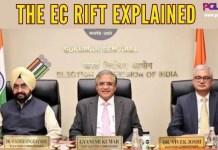

Can India make ECI appointments more balanced?
Two-stage Election Commission appointments process
Election Commission of India (ECI) is one of the most consequential institutions in the world’s largest democracy.
The process by which the Chief Election Commissioner (CEC) and Election Commissioners (ECs) are chosen therefore carries weight far beyond personnel decisions. It shapes public confidence in the fairness of elections themselves.
The current framework, under the CEC and Other ECs, operates in two stages.
A Search Committee, headed by the Cabinet Secretary and two officers of Secretary rank, prepares a panel of five names. Those two members are, in practice, nominated by the Central government; the Act itself is silent on the process of their selection.
The shortlist goes to a Selection Committee comprising the Prime Minister (PM), the Leader of the Opposition (LOP) in the Lok Sabha, and a Union Cabinet Minister nominated by the PM.
The Selection Committee may also consider names outside the shortlist.
Because the Search Committee consists of bureaucracy, it is a fair and realistic assumption that no candidate reaches the shortlist without the consent of the government.
In the current formulation of the Selection Committee, the arithmetic is 2:1 in favour of the executive.
Critics and some judicial observations have described this as an ‘effective veto.’
These structural realities must be placed in proper historical, constitutional, and even global contexts.
What the Constitution actually requires
The Constitution contemplates that appointments to the ECI shall be made by the President subject to any laws made by the Parliament.
For decades the executive exercised that power without any restraint. Successive governments, mainly the Congress party, enjoyed an essentially unfettered right to choose the incumbents.
The brief interregnum created by the Supreme Court’s (SC) interim directions in a 2023 judgment was an exception.
A legitimate government interest, and its limits
It is legitimate for any government to retain meaningful influence over the choice.
The logic is that an opposition, or any external actor, should not be able to impose a candidate who could actively sabotage the functioning of a duly elected government.
This principle is recognized the world over.
That protective interest is already secured, in significant measure, by the shortlisting stage itself.
Yet legitimacy in a constitutional democracy is not only about formal power; it is also about perception.
India is not merely the largest democracy; it is, by any honest comparative standard, not necessarily Western, among the fairest and most successful, if not the most successful, democracies within the constraints imposed by democracy as a form of government.
The periodic spectacle of contested legitimacy in older democracies, including the US, only underscores India’s achievement.
India is a model not only for the developing world but for the entire democratic world at large.
That standing is strengthened when institutional processes are scrupulously balanced further.
Where the perception problem lives
The present Selection Committee, despite its formal compliance with the Constitution, leaves a residual perception problem.
The third member is a Cabinet Minister nominated by the PM. In practice, that member is unlikely to diverge from the government’s preference.
It is true that the inclusion of LOP ensures transparency and the ability to record dissent. However, despite its constitutionality, it is ineffective against the two government members.
A neutral third seat
A modest correction would address this without disturbing the constitutional equilibrium.
The third seat on the Selection Committee could be occupied by a retired judge of the SC or an HC, nominated by the Chief Justice of India (CJI) for a fixed multi-year term. The nomination would be made once, for a defined period (say 3 to 5 years), rather than ad hoc for each vacancy.
Using a retired judge avoids the awkwardness of the sitting CJI participating in a process that the SC itself may have to adjudicate later.
The shortlisting stage, already reasonable under government control, would continue to ensure that candidates not acceptable to the executive don’t reach the final panel.
Plugging the loophole
A further refinement is warranted.
Under the present Act, the Selection Committee may consider persons outside the Search Committee’s panel.
While this flexibility is valuable in rare circumstances, it carries the risk that a candidate unacceptable to the government or the LOP (or even the third member) could be selected by majority.
To close this gap, any recommendation of a person not included in the Search Committee’s shortlist should require the unanimous approval of the Selection Committee.
This single additional requirement would reinforce the constitutional balance already secured by a reasonable government-controlled shortlisting, without eliminating necessary flexibility.
The amendment could explicitly record that the revised composition of the Selection Committee operates within the framework of a shortlisting procedure that respects the government’s constitutional role.
Such a change may strip the government of its unilateral choice, but not its fair and legitimate influence. It would simply add a visibly neutral voice at the final stage of selection.
What it would gain is an enhanced claim to institutional legitimacy, something no government that values democratic capital should lightly discard, esp. in the context of the objections raised in recent times.
India’s democratic record is strong enough to withstand scrutiny and confident enough to improve upon it.
How other democracies handle this
Comparative global experience reinforces rather than weakens this balance.
Across major democracies, like the US, UK, Canada, Germany, Australia and South Africa, the government or the executive retains a meaningful, if not exclusive, role in the appointment of the electoral management body, whether through formal nomination, advice to the head of state, or majority influence in the appointing institution.
Completely government-free selection processes are exceptional. Costa Rica is the only case I could identify; its SC appoints the CEC equivalent by a two-thirds majority. In India, this would place an additional burden on an already overloaded judiciary. In any case, it will overturn the constitutional requirement of government role.
Striking a fair balance
India’s framework, the current as well as the one I propose, is therefore not an outlier in preserving executive influence.
What distinguishes the proposed designs is the addition of visible checks, viz., parliamentary involvement, multi-party consultation, and a neutral institutional voice, all of which enhance public (and even global) confidence without stripping the government of its legitimate safeguard.
The refinements proposed here move in exactly that direction.
Ensuring that the body which referees elections is chosen through a process that is both constitutionally grounded and perceptibly balanced is not a concession to critics; it is an investment in the institution’s long-term authority, and furthering India’s claim as the world’s best functioning democracy.
Note:
1. Text in Blue points to additional data on the topic.
2. The views expressed here are those of the author and do not necessarily represent or reflect the views of PGurus.
For all the latest updates, download PGurus App.

- Making EC selection world-class without losing executive control - September 28, 2026
- How well do ‘vote chori’ allegations stand up to evidentiary scrutiny? — An academic study - September 27, 2026
- Why ‘One Nation, One Election’ could be suicidal for BJP - September 22, 2026