

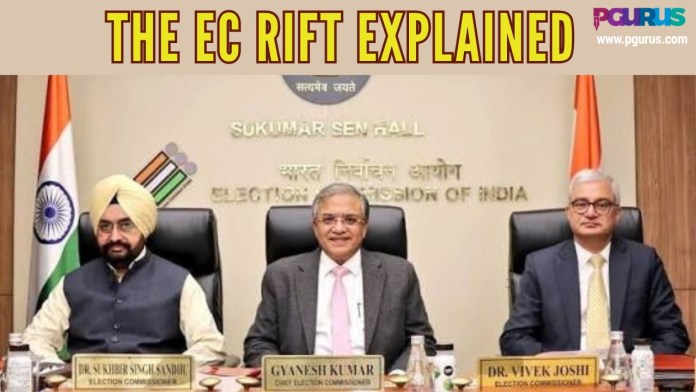
Row comes as Special Intensive Revision has already struck 13 crore names from India’s draft electoral rolls
The Election Commission of India pushed back on Wednesday against reports of internal discord among its members, saying that written notes, observations, technical suggestions and internal checks and balances are standard practice within the poll panel, and that differing views during deliberations are a normal part of its decision-making process.
The Commission’s statement came amid a political firestorm triggered by a series of reports in The Indian Express, which claimed that Election Commissioners Sukhbir Singh Sandhu and Vivek Joshi had placed formal, on-record objections at least fourteen times over ten months against decisions taken in the Commission’s name — some of which, they said, were taken without their knowledge.
What the objections covered
According to the investigation, the flagged issues included a change to Form 6, the form used for new voter registration, which now ties registration to the last Special Intensive Revision (SIR) conducted in the early 2000s. The commissioners also raised concerns about restricted access to the electoral roll database — ERONet and ECINet — for Electoral Registration Officers, unauthorised appeals filed in West Bengal against voters whose names courts had ordered restored, and a software glitch that left 97 eligible voters off Goa’s final electoral rolls.
The newspaper reported that it sent a questionnaire to the Commission and emailed both commissioners on September 21, followed up by phone, but received no response from either before publication.
Commission’s defence
In its statement, the EC said highlighting specific internal notes and observations spread over ten months, while overlooking a much larger body of approvals, decisions, instructions and initiatives, presented only one part of the picture. It added that all decisions taken by the full Commission over the past year were unanimous, and that its digital platforms, including ECINet, operate under strict data-security protocols, while Electoral Registration Officers and District Election Officers exercise their statutory powers for voter roll management independently.
The Commission’s position echoes a broader, long-standing legal framework: dissenting views among commissioners have surfaced periodically since a 1995 Supreme Court ruling held that the Commission’s business should be conducted by unanimous decision as far as possible, with the rule of majority prevailing where consensus isn’t reached.
Opposition seizes on the report
The disclosures triggered a sharp political reaction. Opposition leaders accused Chief Election Commissioner Gyanesh Kumar of “one-man autocracy” and demanded his removal. Shiv Sena (UBT) chief Uddhav Thackeray alleged unprecedented arbitrariness within the Commission, saying two of its three members had complained about the CEC’s conduct, and called it a grave threat to democracy. He accused the EC of manipulating voter lists and cited large-scale deletions in West Bengal and Tamil Nadu, demanding Kumar’s arrest and fresh elections in Maharashtra, Tamil Nadu and West Bengal.
Backdrop: the SIR controversy
The dispute lands against the backdrop of the Commission’s ongoing Special Intensive Revision of electoral rolls, which has already struck roughly 13 crore names from draft rolls nationwide and made the EC a focal point of public debate over voter eligibility. The Supreme Court upheld the legal legitimacy of the SIR exercise in May 2026, ruling it consistent with the Representation of the People Act and within the Commission’s constitutional mandate to ensure free and fair elections.
For all the latest updates, download PGurus App.

- “Ladakh is an integral part of India, no denial can change this”: MEA hits back at China over naming of 28 locations - October 13, 2026
- “Why You Come Here?”: Muhammad Yunus Heckled by Bangladeshi Expats at New York’s JFK Airport - October 13, 2026
- “Rahul Gandhi Yanked My Hand, I Fell”: Pregnant Journalist’s Shocking Claim - October 13, 2026


